Imagine two companies with the exact same customer support operation.
Both have 200 support representatives. Both decide that AI is going to fundamentally change how their teams work. Both give their employees access to the best models available.
A year later, they look very different.
Company A: AI on Every Desk
Company A buys 200 Claude seats. The mandate is simple: use AI to do your job better.
Some representatives become power users. They build elaborate prompts, connect their own tools, and figure out clever ways to get more context into the model. Others use AI occasionally to rewrite emails. Some barely touch it. The best workflows spread through Slack and word of mouth, with no central system for capturing what works.
Meanwhile, the CFO watches the token bill climb. The company knows how much AI it is using. It has a much harder time explaining what that usage is actually producing.
Company B: AI as an Operating System
Company B takes a different approach.
Instead of asking 200 representatives to figure out AI individually, it creates a small team whose job is to improve the support operation with AI.
When a customer ticket arrives, an automatic event-triggered agentic workflow determines what the customer is asking and what information is needed. It retrieves relevant product data, Salesforce records, previous interactions, and other institutional context. It then produces a recommended response for a support representative to review.
The representative still has Claude. They can still experiment and build their own workflows. But the company has also built a layer of AI that works for the entire organization.
And because that workflow is centralized, the company can measure it. It knows how many tickets it processes, how often humans accept its recommendations, where it fails, how much each ticket costs, and whether it is actually improving the business.
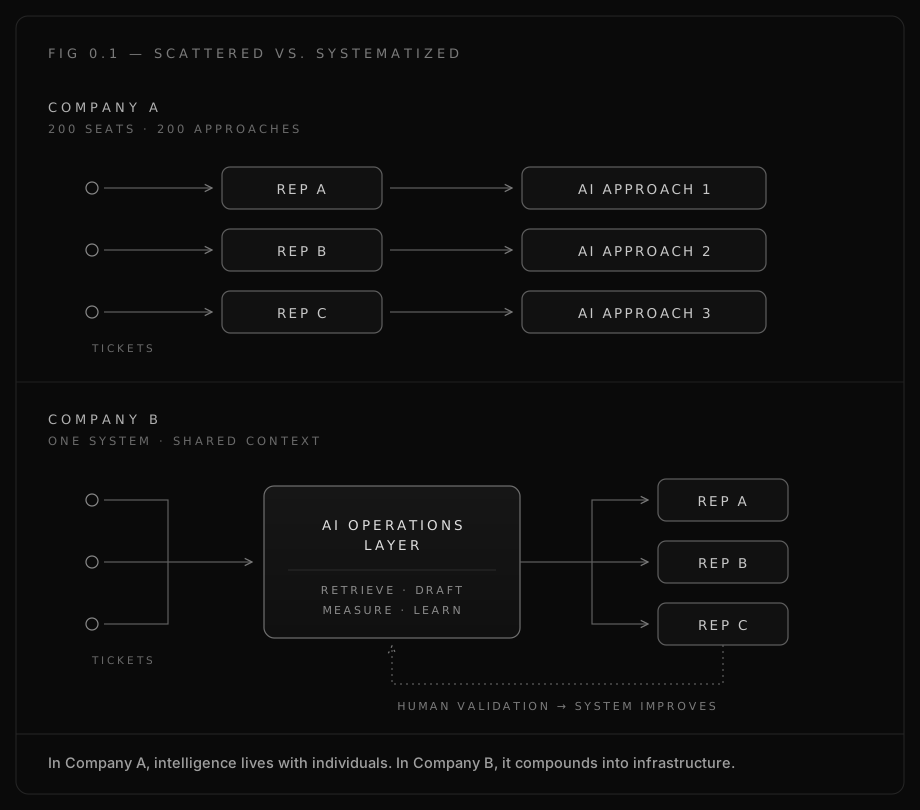
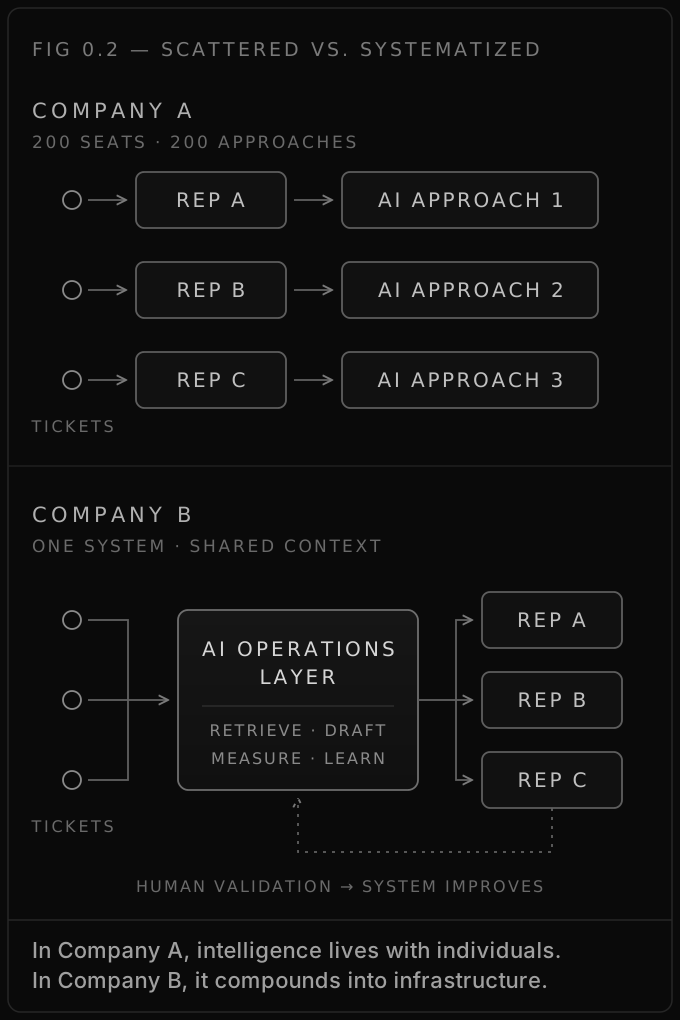
The difference between these two companies isn't whether their employees have access to AI. Both do. The difference is where the intelligence lives. In Company A, AI lives primarily with individual employees. In Company B, AI becomes part of the company's operating infrastructure.
That is the shift I think most companies are missing.
Why Is Company B Actually Better?
The centralized model has several fundamental advantages.
01Better AI outputs
The quality of an AI system is heavily dependent on the context and workflow surrounding the model.
A support representative working from a blank Claude window has to know what information to provide, where to find it, and how to structure the prompt. Oftentimes, the right context is buried in a data warehouse where the CSM wouldn't know to look, even if they were technically fluent. A centralized system can do all of that automatically.
The team building that system can spend its time engineering the workflow: determining which data sources matter, how they should be retrieved, which model should handle each task, and where a human should remain in the loop. That's a very different level of optimization than asking every employee to become their own AI engineer.
02Better economics
Centralization also makes AI spending much easier to manage.
It's difficult to forecast how many tokens 200 people will consume next month. It's much easier to forecast how many customer tickets the business will receive. Once AI is embedded into specific workflows, you can optimize the cost of those workflows: routing simple classification tasks to cheaper models, reserving frontier models for complex reasoning, caching what can be cached, and monitoring cost per outcome.
This matters because AI consumption is becoming a real line item, and unlike traditional software, it can be difficult to predict. The answer isn't to use less AI. Token spend should increasingly be viewed as a variable component of labor, and the question is whether that spend creates enough value. A well-designed AI strategy drives the cost per task down over time, and good backend infrastructure makes decentralized usage cheaper too: if company information is well-structured and easy for agents to retrieve, employees don't burn thousands of tokens repeatedly explaining context.
Instead of asking, "How many tokens are our employees using?" you can ask, "How much does it cost us to resolve a customer ticket?" That's a much more useful question for a business. Otherwise, companies risk solving their headcount growth problem only to create a token growth problem.
03Measurable ROI
Most importantly, the centralized model turns AI into something you can actually measure.
If an agent handles 40% of incoming support tickets, you can measure that. If it reduces median response time from four hours to thirty minutes, you can measure that. If human representatives accept its recommendations 85% of the time, you can measure that.
The unit of measurement becomes the business outcome rather than the AI interaction. This is the fundamental shift: from measuring AI usage to measuring AI performance. And once you can measure performance, you can actually manage it.
04Better organizational intelligence
There is another advantage that is easy to overlook: a well-designed AI workflow doesn't just automate work. It creates a new source of structured, continuously improving data about the business.
Take the customer support example. Imagine every incoming ticket is automatically categorized by an AI system: product bug, billing question, feature request, account issue, documentation gap, and so on. A human reviews the AI's recommendation and gives it a thumbs up or thumbs down.
Now the company isn't just resolving tickets. It is systematically building a high-quality dataset about what its customers are actually experiencing. Over time, that dataset can answer questions that were previously incredibly difficult to answer: Which products generate the most support volume? What problems are increasing? Where are customers consistently getting stuck?
You could theoretically ask hundreds of support representatives to categorize every ticket themselves. In practice, people won't do this consistently or with enough granularity to make the data useful. AI changes the economics of data collection.
The important part is the human in the loop. The AI creates the structure and scale; humans provide validation. Every correction becomes another piece of information that can improve the system. And this principle extends far beyond support: the same architecture applies to sales calls, product feedback, finance operations, and virtually any workflow where a company generates large amounts of unstructured information.
The result is a flywheel: AI does the work, humans validate the output, the company captures structured data, the system gets better, and the company learns more about itself. The AI system is no longer just an automation layer. It becomes an organizational intelligence layer.
So Who Owns This?
If AI is going to become an operating function, someone has to own it.
I don't think that team should look like traditional IT. It shouldn't be a group sitting in the corner of the company waiting for business units to submit requests. It should look more like an internal team of applied AI engineers and operators.
These people need to be unusually versatile. They need to be technical enough to actually build the systems themselves: working with models, APIs, data pipelines, retrieval systems, and agentic architectures. But they also need to be excellent operators and consultants who can sit with a support leader, understand how the team actually works, identify where the bottlenecks are, and translate those problems into systems that can be built.
That's a rare combination. The best person for this role isn't necessarily the best software engineer in the company, nor the best management consultant. It's someone who can walk into an unfamiliar part of the business, understand the workflow, identify where intelligence can create leverage, and then actually build the solution.
And they shouldn't operate from a distance. They should sit with support representatives, listen to sales calls, understand how finance closes the books, and map how information actually moves through the company, not how the organizational chart says it moves.
Then they build.
The building doesn't end at deployment, either. An AI workflow isn't a project; it's a living system. Models change, products change, edge cases emerge, and what worked six months ago may not work today. Every meaningful workflow needs an owner running a simple cycle: deploy, measure, collect feedback, improve, deploy again. The human in the loop isn't a temporary crutch until AI gets good enough to operate alone. In many workflows, the human is a permanent part of the system, providing the judgment and validation that makes it better over time.
That's why this function is fundamentally different from IT. IT maintains the systems the company has. This team is responsible for figuring out what the company could become if its systems were intelligent.
The Real Work Is Infrastructure
Building the agent is only half the job. The other half is making the company understandable to the agent.
Consider the customer support example again. You could build an agent that searches through every Salesforce record, Slack message, call transcript, and product document every time a customer submits a ticket. But that doesn't mean you've built a good system. The underlying information needs to be organized for machines to use.
Sales calls might need to be automatically summarized and tagged with structured metadata. Customer records need to be connected across systems. Product issues need to be classified consistently. Relevant information needs to be embedded so an agent can find it efficiently through semantic or hybrid search.
This is a fundamentally different way of thinking about company data. Historically, we built data infrastructure primarily so humans could analyze it: dashboards, warehouses, reports, BI tools. Now we're increasingly building infrastructure so machines can answer those questions and take action. That means the applied AI team isn't just building agents. It is helping architect the information layer those agents depend on.
And this is where centralization becomes particularly powerful. If five different teams independently build AI workflows, they will create five different approaches to storing, retrieving, and structuring information, duplicating pipelines and solving the same problems repeatedly. A centralized team builds those capabilities once. The support agent uses the same customer intelligence layer as the sales agent. Every new workflow makes the underlying infrastructure more valuable, and the better organized your company becomes for AI, the easier it becomes to build the next AI system.
That's why I don't think enterprise AI is ultimately about building a collection of agents. It's about building the infrastructure that allows an entire company to operate with them.
Are You Saying We Should Take Claude Away From Everyone?
No. Employees should still have access to whatever tools make them more effective. The mistake is confusing personal intelligence with institutional intelligence.
An employee using Claude to write an email or analyze a spreadsheet is valuable, but that intelligence largely benefits the individual. An agentic workflow that analyzes every customer ticket and learns from human feedback benefits the entire organization. These two layers should coexist. The goal isn't to reduce AI usage. It's to make sure that usage compounds into organizational capability rather than remaining a collection of disconnected productivity gains.
From AI Users to AI-Native Companies
The first phase of enterprise AI was about putting a chatbot on everyone's desk. The next phase will be about putting intelligence into the company itself.
That doesn't mean employees stop using Claude, and it doesn't mean every workflow becomes autonomous. It means treating AI as an operating capability rather than another software license. This is what separates AI adoption from AI transformation: in the decentralized model, every employee gets better at using AI individually. In the centralized model, the company gets better at using AI collectively.
The companies that get this right will build teams that understand how work gets done, engineer the infrastructure that makes their information accessible to machines, and continuously turn their workflows into systems that become more intelligent over time. They won't necessarily be the companies that use the most AI. They'll be the companies that get the most leverage from it.
The goal of AI transformation isn't just to give every employee an AI assistant. It's to build a company that can operate intelligently.